
A founder once described marketing in a way I’ve never forgotten:
“I’m not losing customers. I’m losing moments.”
Shopify Marketing Updates 2026: A shopper searches your store and finds nothing.
A previous buyer forgets you because you went quiet for two weeks.
A warm lead bounces because your form feels unfamiliar in their language.
Shopify Winter ’26 shipped 150+ updates across the platform. But the marketing updates all aim at the same outcome: fewer leaky moments and more growth built inside Shopify.
Key takeaways (read this in 20 seconds)
- Shopify is building native growth loops inside admin: messaging (email + SMS), segmentation, forms, planning, and measurement.
- Some of the biggest “distribution” features are region-limited (US / US+Canada).
Best quick wins for most stores: Forms + Segmentation + Consistent Messaging cadence (and a simple calendar plan).
Who this update is for
If you’re one of these, you’ll feel the benefit quickly:
- Store owners who want growth without adding 5 more apps
- Marketing teams who need better targeting + faster campaign building
- Brands going global that want multilingual lead capture + cleaner consent
Performance marketers who want new distribution surfaces + better post-purchase visibility
Quick reality check: availability by region
Some Shopify Marketing Updates 2026 Are Region-Limited
- Shopify Product Network: US only
- Shop Campaigns expands to online stores: US only
- Target all audiences in one Shop Campaign: US & Canada only
- Shop Campaigns on more channels (X, Snapchat, Bing): US only
If you’re outside these regions, don’t skip this guide, because Shopify Messaging (email + SMS where available), segmentation improvements, Forms translation, consent controls, dynamic email sections, calendar planning, and customer-account pixels can still move the needle.
What’s new in one table (save this)
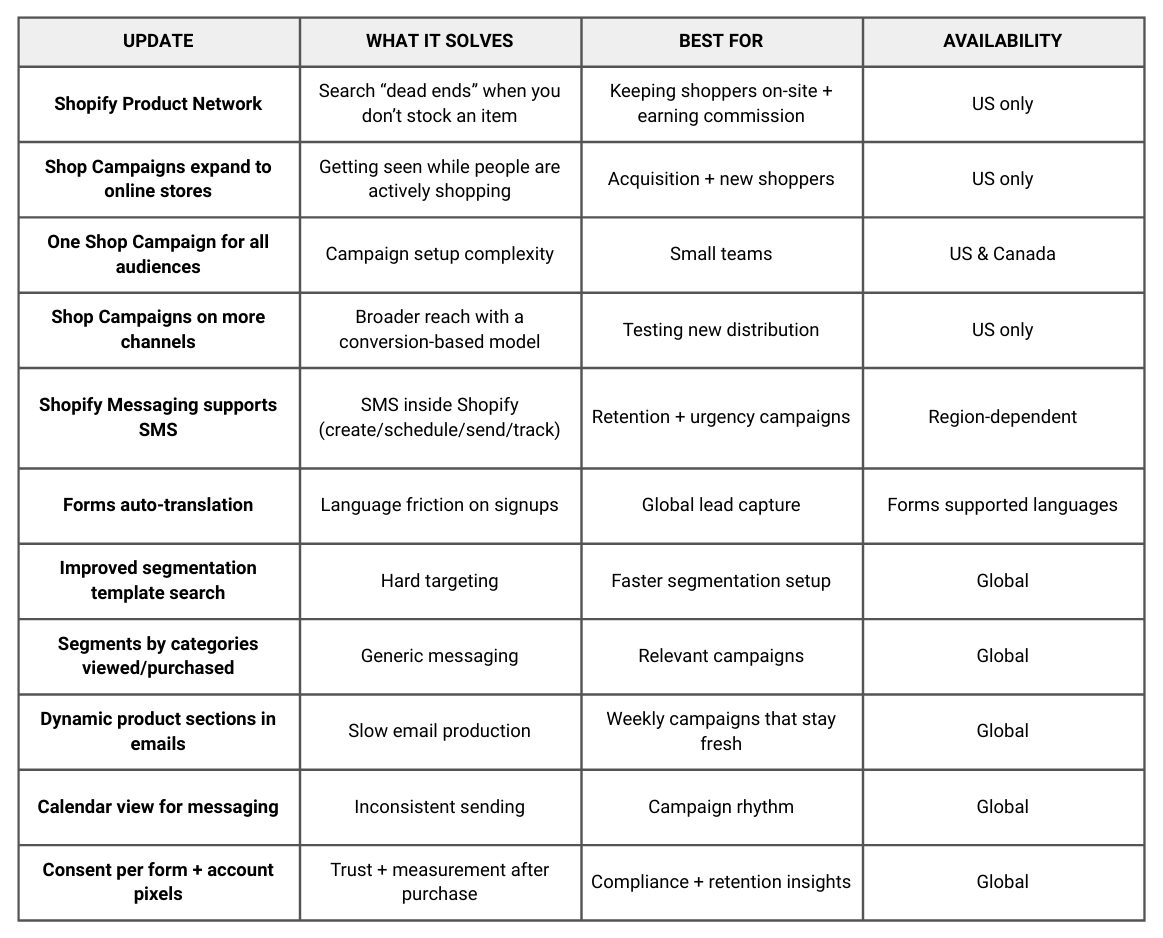
Shopify Marketing Updates 2026 – Explained So You Can Actually Use Them
1- Shopify Product Network: turn “no results” into revenue (US only)
What it is: You can surface products from other Shopify brands inside your store (search, collections, emails, post-purchase) and earn commission on resulting sales.
Why it matters: This patches a silent leak—shoppers leaving because you don’t stock what they searched.
How WebGuru would implement it:
- Start with Search and post-purchase pages (highest intent).
- Curate allowed categories so you don’t dilute brand trust.
- Treat it as a gap-filler, not your main assortment.
KPI to track: Search exit rate, search conversion rate, commission revenue.
2- Shop Campaigns expand to online stores: distribution while shoppers are buying (US only)
What it is: Shop Campaigns can promote you on other Shopify stores (collections, search, post-purchase).
Why it matters: You’re meeting customers in “shopping mode,” not “scroll mode.”
How to use it well:
- Create a specific offer for this traffic (bundle, free shipping threshold, limited-time deal).
- Make your product pages airtight: photos, FAQs, delivery/returns, trust signals.
KPI to track: New customer conversion rate, CAC vs blended CAC, AOV, repeat purchase rate.
3- One Shop Campaign for all audiences (US & Canada only)
What it is: Launch one campaign for all audiences instead of splitting acquisition vs win-back.
Why it matters: Shopify is reducing the “setup tax” that kills consistency.
Best practice: Keep creative and landing copy broad:
- New shoppers → “why this product”
- Returning → “what’s new / why now”
4- Shop Campaigns on more channels (US only)
What it is: Campaign distribution on more channels (including X, Snapchat, Bing) with a conversion-based cost model.
How to approach it: Treat it like a controlled test:
- Start with one hero product.
- Fix post-click friction before scaling.
5- Shopify Messaging supports SMS: keep email + SMS under one roof
What it is: Create, schedule, send, and track SMS marketing campaigns in Shopify Messaging (availability depends on region).
Important limitation: SMS marketing campaigns in Shopify Messaging aren’t compatible with marketing automations.
What this means in real life:
- Use SMS as a sharp tool, not a daily habit.
- Think “drops” (restock, launch, 24–48h promo) instead of constant noise.
A high-performing cadence (simple):
- 2 SMS/month:
- Restock / product drop
- Short promo window
- Restock / product drop
KPI to track: Revenue per recipient, unsubscribe rate, conversion within 24 hours.
6- Shopify Forms auto-translation: remove language friction at the signup moment
What it is: Shopify Forms can auto-translate forms from English into multiple languages (supported languages vary).
Why it matters: If traffic is global, forms are often your first “conversation.” Language friction kills signups.
How to use it:
- Use one high-intent form:
- Back-in-stock signup
- Lead magnet (guide/quiz)
- Exit intent (careful—don’t train customers to wait for discounts)
- Back-in-stock signup
KPI to track: Form conversion rate by country/language, subscriber-to-buyer conversion.
7- Segmentation upgrades: less guesswork, more relevance
How to use it (real examples):
- Category viewers → “Top picks in [Category] + why customers love them.”
- Past buyers of Category A → “Perfect add-ons that pair with your purchase.”
- Win-back → “What’s new since you last visited + a reason to return.”
KPI to track: Revenue per send (by segment), click and conversion rate per segment, repeat purchase rate.
8- Dynamic product sections in emails: speed without feeling generic
What it does: Add dynamic product sections that show best sellers or selected collections.
WebGuru template that works:
- 1 short story/value hook
- Dynamic “Best sellers / New arrivals”
- 1 clear CTA
9- Calendar view for messaging: build a rhythm
What it is: Plan and schedule email + SMS campaigns in a calendar/planner view.
A simple 4-week plan:
- Week 1: Value / education
- Week 2: Product feature
- Week 3: Social proof
- Week 4: Offer
10- Consent per form + customer-account pixels: trust + measurement after checkout
What it is: Set marketing consent per form and enable stronger tracking on customer account pages.
Why it matters: Consent is trust. Better measurement helps improve retention.
Shopify Marketing Updates 2026 – Common Mistakes Businesses Make(we see these all the time)
- Turning on everything at once → messy data and unclear ROI
- Sending SMS too often → list churn and brand fatigue
- No segmentation → low conversions + higher unsubscribes
- Campaigns without landing/offers → distribution doesn’t fix weak conversion
- No calendar → inconsistent marketing, inconsistent revenue
What to implement first (WebGuru priority order)
- Messaging foundation: Email + SMS (if available) with a sensible cadence
- Segmentation: VIP, category viewers, win-back
- Forms: Translation + consent settings
- Email efficiency: Dynamic product blocks + reusable weekly template
- Planning: Calendar view → plan 2–4 weeks ahead
If eligible (US/CA): Product Network + Shop Campaign expansions
7-day rollout plan (copy/paste into your task manager)
Day 1 — Audit leaks
- What do customers search that you don’t stock?
- Where do users drop off?
Day 2 — Forms + consent
- Add 1 high-intent form + set consent
- Enable translation if you target global traffic
Day 3 — Segmentation
- Build VIP, category viewers, win-back
Day 4 — Email template
- Create 1 weekly template + dynamic product section
Day 5 — SMS campaign (if available)
- Build 1 SMS for restock/launch (keep it short)
Day 6 — Calendar
- Plan 2 weeks of campaigns
Day 7 — Measure
- Review results by segment
Adjust timing, offer, messaging
If you want WebGuru.pk to implement Winter ’26 marketing updates properly (not “enable everything and hope”), we can set up:
- Shopify Messaging (email + SMS where available)
- Segmentation strategy + templates
- Forms translation + consent best practices
- A 30-day campaign calendar + reusable email template
- Tracking review (post-purchase visibility)
Want our Winter ’26 Marketing Rollout Checklist (PDF)?
Comment WINTER ’26 and share your niche + target country, we’ll send a tailored rollout plan.
Sources
- Shopify Editions Winter ’26 page (Marketing section) Shopify
- Shopify Help Center: Shopify Messaging SMS marketing campaigns Shopify Help Center
- Shopify Help Center: Translating your forms (Forms app) Shopify Help Center
- Shopify Changelog: multi-language Shopify Forms changelog.shopify.com
- https://webguru.pk/services/shopify-development/
Shopify News: Winter ’26 RenAIssance Edition overview Shopify